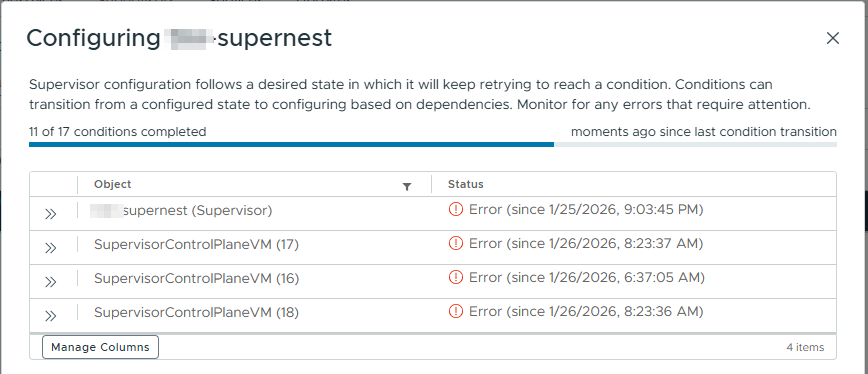
Time ago at one of the customers I was solving deployment of a Supervisor cluster. Really trivial thing, you mean, but I have been facing with a few things, which have not been exactly documented in any KB.
Deployment in the first phase ran really smoothly.
- Cluster with NSX
- Customer is using NSX, resp. VCF in licensing, but installed manually part by part on the vSphere 8.
- Storage policies
- Even when customer is not using vSAN, for Tanzu deployment (vSphere Kubernetes Services), it is required to have Storage policy in place. Using them K8s know where to place persistent objects.
- You have to create Tags for Storage policies
- Assign those Tags to appropriate Datastores, to be at least one Datastore "Compatible" during Storage policy selection.
- Create Storage Policies. If you don't have vSAN in place, they will be created only with Tag based placement.
- Load Balancer
- You have to choose, if you will be using NSX load balancer or you have AVI, during Supervisor creation. AVI is licensed separately, but has more features. You have to decide if it gives you aditional value or not.
- Customer has decided to use "only" NSX.
- 3 IP subnets, which are routable
- 1 for Supervisor MGMT - you can use vDS portgroup.
- 5 consecutive IP addresses
- 1 for Ingress - Services, that will be published outside using LB
- 1 for Egress - access for all containers and TKG cluster to the outside world "SNAT"
- 1 for Supervisor MGMT - you can use vDS portgroup.
- 2 IP subnets for internal K8S connectivity
- 1 subnet pro K8S konektivitu Supervisor Services podů a TKG clusterů
- 1 subnet pro K8S service objekty
- Subnety se nesmí překrývat s jinými supervisor subnety